.png)
How to study


Section One: Introduction
School is about learning both Guided and on your own from getting work done to getting ready for a quiz we all need to know how to study. This skill will never leave you as it is an intrinsic part of our schooling process; and whether we like it or not we will have to learn material, get tested on it and then learn more.It is just as if not more important to learn how to study now than ever before. We’re in high school. Now is the time to study
Why should you study
The consensus of most sources I've reviewed is that the amount of time you spend studying and the amount of effort you put into studying doesn't matter nearly as much as the type of studying that you are doing. According to a study published by the National Institute of Health (NIH), “when students studied less strategically, they had to invest more time to reach a higher goal level.”(Theobald M). Knowing this how can we study more strategically (or with a structure) which does make a difference according to that same study “When students reported better planning, monitoring and concentration as well as lower procrastination, less time was needed to achieve a high goal level”(thoebald M). So how can we study more effectively to make sure that we can reach our goals in as little time as possible.
Human memory is far from perfect according to modern research we forget a lot of the information we learn and we forget it fast this was first observed in 1880 by the scientist Ebbinghaus, and these results of his “Forgetting curve” have been replicated as recently as 2015 (Murre JM, Dros J)suffice to say they have stood the test of time, the 2015 paper found that his original experiment was valid and that his curve of how fast people forget things was accurate with their data validating his findings.

As you can see the graph shows that we forget large percentages of the information we learned with minutes of learning it (this was also observed by the research team in 2015 and Ebbinghaus in 1880.) They also observed the drop immediately of information you simply didn't learn. Knowing this, how can we overcome this curve in order to remember what we need for school. The first method we will discuss is timed review
Section Three: Studying methods
Many study methods are meant to help you overcome the forgetting curve and help you remember information. One thing that can help is a timed review. Time review is great because it can be applied to all sorts of study methods like flash cards, or rereading/rewriting notes. The idea is to simply review the information before you forget it to make sure you remember necessary information. It is recommended you review the information immediately after you learn it, roughly 24 hours of time passing since you learned it the first time, then 1 week after you learned it the first time then 1 month after you learned the information the first time.
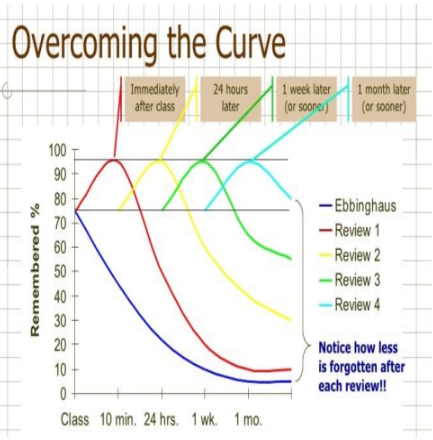
There are other ways of retaining information but timed review seems to be one of the most effective, However, this could be difficult for high school students as we often have other classes right after the class that we would want to study for making reviewing immediately after learning the material difficult to do.
The 2357 method
The 2357 method is useful for long term memorization, information retention, and information retrieval. It uses the principles of spaced repetition (reminding yourself of what things are at designated intervals) to help you remember things for longer. The way you do it is by reviewing material at specific intervals. You are supposed to revise and review your notes each time at intervals of 2 days after you took your notes then 3 days after then 5 days after then finally 7 days after. The way it works is to review information at timed intervals to ensure that you remember what you are studying. It is both a method of studying and a generalized idea about how to learn new information(McMahon and FassForward). It works on the principle of spaced recall which was defined by Birmingham city as“(being) based on the forgetting curve (discovered by the German philosopher Ebbinghaus), which shows how we lose the ability to access information in our memory over time. By studying a topic at strategic intervals, you’ll end up remembering more.” They continued that it has been scientifically proven to work better than just cramming everything in all one one night.
This method can also be used to plan your revisiting session / prep before an exam. As you may have noticed, if your test is not for several weeks after you learned the material, there could be a significant gap between you doing the 2357 method and the test you plan to study for. In this case, you can change the time frame for using the 2357 method so you end up reviewing the material you want to learn the day before you plan on taking the test. To create this time frame, you can do the following: the day before the exam study your last study session Set the next review day two days prior to the last one (the day before the test)( 3 days before your exam) then plan another 3 days before that one (6 days before the exam), then schedule one five days before that ( 11 days before your exam) and then they first one 7 days before that ( a total of 18 days before your exam) this framework is provided by birmingham university and they make sure to mention it is just a framework so be sure to adapt it to your needs.
Pomodoro
The Pomodoro Technique (paw- ma-dor-oh) method is based on getting tasks done. It can be used for studying, getting class work done or working on big projects. It is a method to stay on task and on schedule and it works like this: you set a single task to focus on you then work for 25 minutes earnestly working on that task then a 5 minute break you repeat that cycle for four rounds before then taking a longer more relaxed break for thirty minutes. It is incredibly important to stay on task during those 25 minutes as said by the university of Arizona “ The key during the pomodoros is to limit distractions like your phone, other apps on a computer, or anything else that may take away your attention. The goal is to get a small chunk of focused time to help you get moving on your larger project, and then build on that momentum with consecutive chunks of time.” (Patrick) The pomodoro technique is incredibly versatile with the author mentioning that you could use thai technique to review notes, study for a test, or even just write a paper it can be used for all of those situation
Notes
While it may seem boring taking notes, taking notes is important. Multiple authors suggest that note taking correlates to higher achievement when done correctly. This topic was covered extensively in an article published in 1981 BY Gurung, R. “Research indicates that students are generally incomplete note takers recording a relatively small percentage of critical lecture ideas” These same researchers found that average or below average students only collected about 11% of the ideas in a lecture. Whereas "A" students noted 62% of the critical lecture ideas”(Kiewra, Kenneth A). It should be noted that note taking appears to be beneficial even if you don't review your notes later. As the paper says “(note taking) increases attention during the lecture and facilitates encoding of lecture ideas into long term memory” (Kiewra, Kenneth A) .
The Authors explain that simply taking notes in whatever manner you choose is not sufficient to get higher grades. To do better academically, you need to be able to take effective notes. The paper continues by taking about how to take effective notes. In short, write more.. “Research, however, indicates that notes containing more ideas and more words (Kiewra and Benton, in press; Kiewra, Benton and Lewis, in press; Kiewra and Fletcher, 1984; Kiewra and Frank, in press) are related to higher achievement. So for us students, the message is clear. Don’t be shy. Use up a lot of pages and be sure to take detailed and lengthy notes.
Well it may sound like the recommendation is to just write down the lecture word for word. In actuality it is important to write at length about important concepts, not every concept (Kiewra, Kenneth A). But how you differentiate between the two can be difficult at times and unfortunately as students there is little that we can directly do about it. We have to rely on our teachers to let us know what ideas are more important than others and then to test us on the most important idea. In my personal experience, I have seen some cues that teachers have used. When there is a diagram or a phrase that is highlighted, written on the board, or repeated multiple times in the same class, The teacher was usually telling me to write that down.These skills can be difficult to learn but essential to master in order to succeed in high school; and especially important if you were to decide to attend college. But of course this will vary from teacher to teacher so you just have to take it one a case by case basis
The same paper highlights the importance of review as well but does caution that if students were not thorough that their review of the ideas would be incomplete but regardless review of notes is correlated to their academic achievement and success (Kiewra, Kenneth A)
For reviewing notes there is always the classic active recall this is what you would do in a pomodoro session or on one of you designated review days for the 2357 method (for further clarification see above) The idea is simple test how much you remember th active recall works by moving information from short term memory to long term memory by constantly revving information and challenging your brain (Birmingham City) they recommend the classics of flashcards ( self explanatory to use), Practice questions (these can be difficult to set up and or create but very useful), The finemean technique (will be discussed later), summarizing(self explanatory), and blurting which requires some explanation it is where you simply write down everything and everything you can remember about the topic of study. (list from (Birmingham City University))
The Feynman technique is useful for concepts and ideas, not for memorizing facts. It is based on the principle that understanding comes with the ability to summarise and simplify. And that summarizing and simplifying will help your understanding.The Feynman technique is simply put, teaching someone else about the subject in order to make sure you understand it well enough yourself. It works in four steps. The first is to choose a subject (the subject of study in this case) you then put everything you know on one piece of paper, then you “ explain it to a 12 year old” (Farnam Street). This just means explain the subject ( to yourself if you have to) in language that a child would understand. You can then write it down. You then read and review how you did looking for areas where you don't understand things as well as you would like to and then refine and improve your explanation. Finally you test your understanding by actually trying to teach it to someone else and finally archive your simple explanation for later. (Farnam Street)
But of course it's hard to study with out help luckily their are tools out their to help
STUDY TOOLS
While, of course nothing will ever replace old fashioned pencil and paper there are now tools on the internet to help you learn from things to help you make flashcards and practice questions to premade sets for memorization. We will cover only a sliver of what the internet has to offer.
YouTube
While it can be risky with getting distracted and you always have to be careful with misinformation (as with anyplace on the internet) there are millions of videos on youtube that will explain concepts, go through practice problems or summarize huge amounts of information very quickly. But as always you need to be careful as misinformation is rampant on the internet (anywhere you look) and youtube is no exception you just need to remain vigilant and make sure to vet your sources before trusting them fully.
Turbo ai
This is a study tool that claims to “Turn anything into notes, flashcards, quizzes, and more.” (Turbo ai) it's main selling point is that it turns basically anything into notes: lectures,pdfs, youtube videos, google docs, word documents and more. It can also make quizzes and flashcards to help with active recallThe creators of it say it has a 99% accuracy rate (Turbo ai), and that it functions as an assistant to you while you're studying, recommending changes to clarify (Turbo ai). To start with it you need to sign up. It should be noted that the website is blocked by PSD and also that the author of this piece as well as anyone associated with the publishing production or distribution of this article does NOT condone the use of this product. But it does exist so if you were to choose to use it do so with care and remember it is an ai product and is fallible so be careful.
Anki
It is a flashcard program. It makes flash cards for you and only flash cards it lets you make flash cards and has you rate how hard it felt allowing you to change what material is reviewed. (Anki) it also lets you make and share your flashcards and view decks that others have made as well (Anki) letting you learn from what others have made.
Quizlet
It is more common in high school than others mentioned. It is quite versatile especially for one subject learning and memorization. Quizlet offers you a variety of methods to memorize facts it has a dedicated learn mode, flash cards games, matching, and more aplications. All of teh studying materials are made by other people and can be made by yourself but they have huge libraries to pull from if you need it. (quizlet)
Studying is hard and there is no one perfect method (Gurung, R.) so be sure to try out what works for you to see what helps and what doesn't. Speaking from experience the library is the perfect place to go study and get work done. It's quiet and focused. And be sure to use whatever techniques work for you.
Citations
Works Cited
Anki. “Ankiweb.” Anki - powerful, intelligent flashcards, https://apps.ankiweb.net/. Accessed 22 March 2026.
Auburn University. “The forgetting Curve.” https://www.eng.auburn.edu/current-students/documents/forgetting-curve.pdf. Accessed 9 3 2026.
Birmingham City. “What is active recall? The best study method explained (and how to use it).” bcu.ac.uk, 11 March 2025, https://www.bcu.ac.uk/exams-and-revision/best-ways-to-revise/active-recall. Accessed 22 March 2026.
Birmingham City University. “Spaced repetition and the 2357 method - Exams and Revision.” Birmingham City University, Unknown, https://www.bcu.ac.uk/exams-and-revision/best-ways-to-revise/spaced-repetition. Accessed 11 March 2026.
Farnam Street. “Feynman Technique: The Ultimate Guide to Learning Anything Faster.” Farnam Street, https://fs.blog/feynman-technique/. Accessed 22 March 2026.
McMahon, Gavin, and FassForward. “Beating Ebbinghaus - How to bend the forgetting curve.” FassForward.com, 2019, https://www.fassforward.com/our-thinking/beating-ebbinghaus-how-to-bend-the-forgetting-curve. Accessed 9 3 2026.
Patrick, Brian W. “Use Procrastination to Your Advantage with the Pomodoro Technique.” thrive.arizona.edu, 2026, https://thrive.arizona.edu/news/use-procrastination-your-advantage-pomodoro-technique. Accessed 11 March 2026.
Quizlet. “Take Quizlet with you.” Quizlet, https://quizlet.com/goodbye. Accessed 22 March 2026.
Turbo ai. Turbo AI - AI Note Taker & Study Tools, https://www.turbo.ai/. Accessed 22 March 2026.
University of Pitsburg. “Pomodoro Technique | Dietrich School of Arts & Sciences Undergraduate Studies.” Dietrich School of Arts & Sciences Undergraduate Studies, https://www.asundergrad.pitt.edu/study-lab/study-skills-tools-resources/pomodoro-technique. Accessed 11 March 2026.
Theobald M. Study longer or study effectively? Better study strategies can compensate for less study time and predict goal achievement and lower negative affect. Br J Educ Psychol. 2025 Jun;95(2):405-420. doi: 10.1111/bjep.12725. Epub 2024 Oct 30. PMID: 39474752; PMCID: PMC12068007.
Murre JM, Dros J. Replication and Analysis of Ebbinghaus' Forgetting Curve. PLoS One. 2015 Jul 6;10(7):e0120644. doi: 10.1371/journal.pone.0120644. PMID: 26148023; PMCID: PMC4492928.
Kiewra, Kenneth A. "Notetaking and review: The research and its implications." Instructional Science 16.3 (1987): 233-249.
Gurung, R. "How do students really study (and does it matter)." Education 39 (2005): 323-340.
B. F. Brookings is a student a Poudre high school who is in serval clubs he likes good food hanging out with his cat and good entertainment.


Comments