.png)
From Nothing to Everything: Understanding the Big Bang

One of the biggest questions humans have ever asked is this: How did the universe begin? The most widely accepted scientific answer is the Big Bang Theory, a concept that explains how our universe sprang into existence from an incredibly hot, dense state and began expanding into the vast cosmos we see today. Although the name may sound dramatic, it isn’t a “bang” like a traditional explosion. Instead, it describes a rapid expansion of space itself. The Big Bang Theory gives us a framework for understanding the origin and growth of the universe based on evidence gathered by scientists for nearly a century.

The story begins around 13.8 billion years ago, when all of the universe’s energy and matter were compressed into a tiny point often called a singularity. At this moment, conditions were extreme—temperatures were unimaginably high, and space as we know it didn’t exist. Then, in a fraction of a second, the universe began expanding. This initial expansion was not matter flying through space, but space itself stretching and creating room for everything to exist. As the universe expanded, it also cooled. This cooling allowed the first particles to form, including protons and neutrons, which later combined to create the first simple atoms.

Within the first few minutes, the universe was filled mostly with hydrogen and helium, the lightest elements. Over millions of years, clouds of these elements gathered under gravity to form the first stars and galaxies. Inside these stars, nuclear fusion forged heavier elements like carbon, oxygen, and iron. When massive stars reached the end of their life cycles, they
exploded as supernovae, spreading heavier elements across space. Those elements eventually became parts of planets, asteroids, and even living organisms. In this way, the materials that make up our bodies and world are literally products of processes that began after the Big Bang.

The evidence supporting the Big Bang Theory comes from multiple observations made by astronomers over decades. One of the first major pieces of evidence was the discovery that galaxies are moving away from us in all directions. This observation, first identified by astronomer Edwin Hubble in the 1920s, shows that the universe is expanding. If galaxies are moving apart now, then logically they must have been closer together in the past. This matches the idea that the universe began in a much more compact state. NASA explains that this expansion can be measured by the redshift of light from distant galaxies, where wavelengths stretch as objects move away from us. Light shifted toward the red end of the spectrum tells astronomers that space itself is expanding.
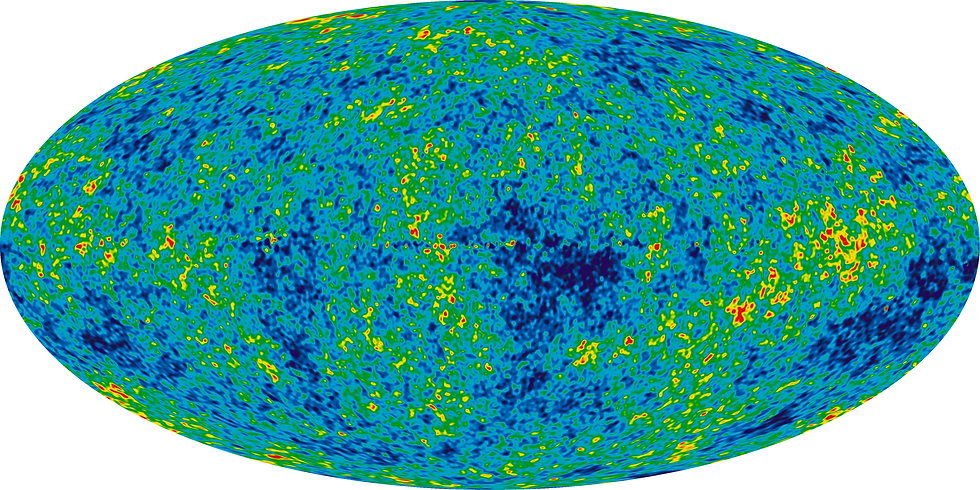
Another key piece of evidence is the cosmic microwave background radiation (CMB), a faint glow left over from the early universe. In the 1960s, scientists detected this radiation uniformly filling the entire sky. The CMB is considered a “snapshot” of the universe when it was only about 380,000 years old—still very young on a cosmic scale. NASA describes the CMB as the oldest light we can observe, and its uniform properties align with predictions from the Big Bang model. Tiny variations in the CMB also give clues to the distribution of matter in the early universe, which helped shape the formation of galaxies later on.

Modern technology, such as the Wilkinson Microwave Anisotropy Probe (WMAP) and the Planck satellite, has allowed scientists to map these tiny fluctuations in the CMB with incredible precision. These detailed maps confirm key predictions of the Big Bang theory, including the universe’s age, composition, and rate of expansion. According to NASA, the universe is approximately 68% dark energy, 27% dark matter, and only about 5% regular matter—the stuff we can see and touch. Dark energy is thought to be responsible for accelerating the expansion of the universe, a discovery that earned the 2011 Nobel Prize in Physics.
The Big Bang Theory is supported by converging evidence from physics, astronomy, and cosmology, and it remains the best explanation we have for the origin and evolution of the universe. However, scientists continue to investigate unanswered questions, such as what caused the initial expansion and what exactly happened before the first fraction of a second. Future research—possibly including even more advanced space telescopes—could reveal new insights into these mysteries.
In conclusion, the Big Bang was not just a beginning, but the start of an ongoing story of creation, growth, and change. From a tiny, hot, dense point to the complex universe we see today, the journey of the cosmos spans billions of years and continues to be written. By studying light, motion, and ancient radiation, scientists have turned the seemingly impossible into understandable science, showing how the universe grew from nothing into everything.
Sources Used
• NASA – Big Bang Theory Overview (NASA.gov)
• NASA – Cosmic Microwave Background (NASA WMAP and Planck Missions)
• NASA – Expansion of the Universe and Redshift
• “A Brief History of Time” by Stephen Hawking• “Cosmos” by Carl Sagan


Comments