.png)
Artimis II Mission: The Farthest a Human Has Ever Been from Earth


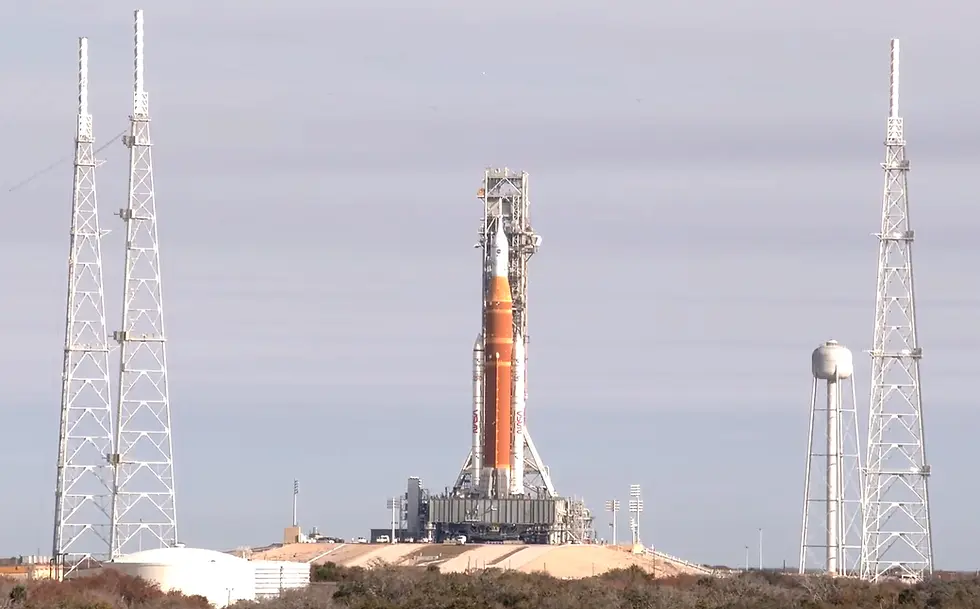
Artemis II is the latest N.A.S.A. mission. This mission will be the farthest a human has ever traveled from Earth. The image to the right is of the impressive three-stage rocket system on its launch bay on February 24, 2026, before the rocket was called back due to high winds and a helium leak, with a launch date of "no later than April 1st." It will not be a landing; it will be a fly-by. Even though these delays can be frustrating, they are a normal part of spaceflight preparation, where safety and precision are more important than launching quickly. Brooks Mendenhall notes that “engineers discovered that a seal blocking helium flow needed to be repaired before the rocket could safely launch” (Mendenhall, Astronomy Magazine, March 5, 2026). The current plan is for the mission to launch no later than April 1st. Unlike some earlier lunar missions, Artemis II will not land astronauts on the Moon; instead, the crew will perform a fly-by around the Moon before safely returning to Earth. While that might sound simple, the mission is actually extremely complex and will test many systems that are necessary for future missions. Artemis II is not just another space mission—it is a major test that will help determine how humans explore deep space in the future.

To understand why Artemis II is important, it helps to first understand what the mission is designed to do. The goal of the mission is to send a crew of astronauts around the Moon and safely bring them back to Earth. This type of mission is called a lunar fly-by, meaning the spacecraft will travel around the Moon using its gravity to help guide the spacecraft back toward Earth. Christian Davenport explains that “Artemis II is a critical step toward building a long-term human presence on the Moon” (Davenport, The Washington Post, February 24, 2026). The astronauts will travel aboard the Orion spacecraft, which is designed to support humans during long journeys far beyond Earth’s orbit. Unlike spacecraft used to travel to the International Space Station, Orion must operate in deep space where astronauts are exposed to stronger radiation and harsher conditions. During the mission, the spacecraft will travel hundreds of thousands of miles away from Earth. At its farthest point, the crew will be farther from Earth than most astronauts in history. While the astronauts will not land on the Moon, the mission still plays a crucial role in testing systems needed for future lunar landings. Artemis II is part of the larger Artemis Program, which aims to return humans to the Moon for the first time in decades. Later missions will attempt to land astronauts near the Moon’s south pole, where scientists believe frozen water exists inside permanently shadowed craters. This water could help astronauts survive long missions by providing drinking water, oxygen, and even rocket fuel.


To send astronauts this far into space, NASA developed an extremely powerful rocket called the Space Launch System, often shortened to SLS. Loren Grush describes it as “one of the most powerful rockets ever built” (Bloomberg, February 25, 2026). This rocket is designed specifically for deep-space missions and uses a three-stage system to carry the spacecraft into space. The first part is the core stage, which contains large fuel tanks and powerful engines that provide the main thrust during launch. Attached to the sides of the core stage are two massive solid rocket boosters. These boosters help generate the enormous amount of power needed to lift the rocket off the ground. During the first few minutes of launch, the boosters and engines fire together to push the rocket through Earth’s atmosphere. Once the boosters run out of fuel, they separate and fall away from the rocket. After that, the core stage continues firing until the spacecraft reaches space. Finally, the upper stage of the rocket pushes the spacecraft onto a trajectory toward the Moon. Without a rocket as powerful as the SLS, it would be extremely difficult to send astronauts and all their equipment so far away from Earth.

At the very top of the rocket sits the Orion spacecraft, the spacecraft that will carry astronauts during the Artemis II mission. Orion is designed specifically for long missions in deep space. Inside Orion is the crew module, which is where the astronauts live and work during the mission. This module contains seats, controls, life-support systems, and computers that help the astronauts manage the spacecraft. The spacecraft also includes a service module, which provides propulsion, electrical power, oxygen, and temperature control. This service module was developed with help from the European Space Agency. One of the most important parts of Orion is its heat shield. When the spacecraft returns to Earth, it will travel extremely fast through the atmosphere. This creates intense heat caused by friction with the air. The heat shield protects the spacecraft and astronauts from temperatures that can reach several thousand degrees. Orion is also designed to handle the harsh environment of deep space. Unlike spacecraft that stay close to Earth, Orion must protect astronauts from radiation and extreme temperature changes.
Space exploration always involves challenges, and Artemis II is no exception. Even before launch, engineers must carefully monitor weather conditions, rocket systems,

and spacecraft equipment. The earlier delay caused by strong winds and a helium leak is a good example of the kinds of problems engineers must solve. Helium is often used to pressurize rocket fuel systems, so any leak must be repaired before launch to prevent serious issues during flight (Mendenhall, Astronomy Magazine, March 5, 2026). Another challenge is the environment of deep space. Once the spacecraft leaves Earth’s orbit, astronauts are exposed to higher levels of cosmic radiation. Engineers design spacecraft systems to protect astronauts as much as possible, but this environment is still more dangerous than low Earth orbit. Navigation is also very important. The spacecraft must follow a precise path so that the Moon’s gravity helps guide it back toward Earth. Even small errors in the flight path could require large corrections. Communication is another challenge because signals take longer to travel as the spacecraft moves farther away. Mission control must ensure communication systems remain strong and reliable throughout the mission. Despite these challenges, NASA carefully plans and tests every system to ensure the mission has the highest chance of success.
Artemis II is an important step toward the future of space exploration. The mission will test spacecraft systems, astronaut procedures, and technologies needed for future lunar landings (Davenport, The Washington Post, February 24, 2026). If Artemis II succeeds, later missions in the Artemis Program will attempt to land astronauts on the Moon again. Scientists are especially interested in exploring the Moon’s south pole because of the possibility of water ice. The mission also represents a new era of international cooperation in space exploration. Organizations like the European Space Agency are working together with NASA to make these missions possible. For many people around the world, Artemis II will also serve as inspiration. Seeing humans travel far beyond Earth once again reminds us that exploration is still an important part of human progress. By completing this mission, NASA will take another major step toward returning humans to the Moon and preparing for future missions to even more distant destinations, such as Mars.
Bibliography
Chang, Kenneth. “NASA’s Artemis II Prepares to Send Humans Around the Moon.” The
New York Times, February 20, 2026.
Davenport, Christian. “Why Artemis II Matters for the Future of Moon Exploration.”
The Washington Post, February 24, 2026.
Grush, Loren. “Artemis II and the New Space Race.” Bloomberg, February 25, 2026.
Koren, Marina. “Why Artemis II Is a Milestone for Diversity in Space.” The Atlantic,
February 23, 2026.
Mendenhall, Brooks. “Artemis 2 Inches Closer to Launch After Helium Fix.” Astronomy
Magazine, March 5, 2026.
Wattles, Jackie. “Inside the Training for NASA’s Artemis II Crew.” CNN, February 22,
2026.

Simon Belda is a junior in high school and is in their first year with the Poudre Press. They are known for being leaders on the robotics team, and they enjoy exploring the natural and mechanical worlds through photography. After high school, they plan to attend an engineering college for aerospace engineering.


Comments